Author: jacoblevin

  • How a Prison Weapon Case Ended Before Closing Argument

    How a Prison Weapon Case Ended Before Closing Argument

    Two Reasonable Explanations means Not Guilty
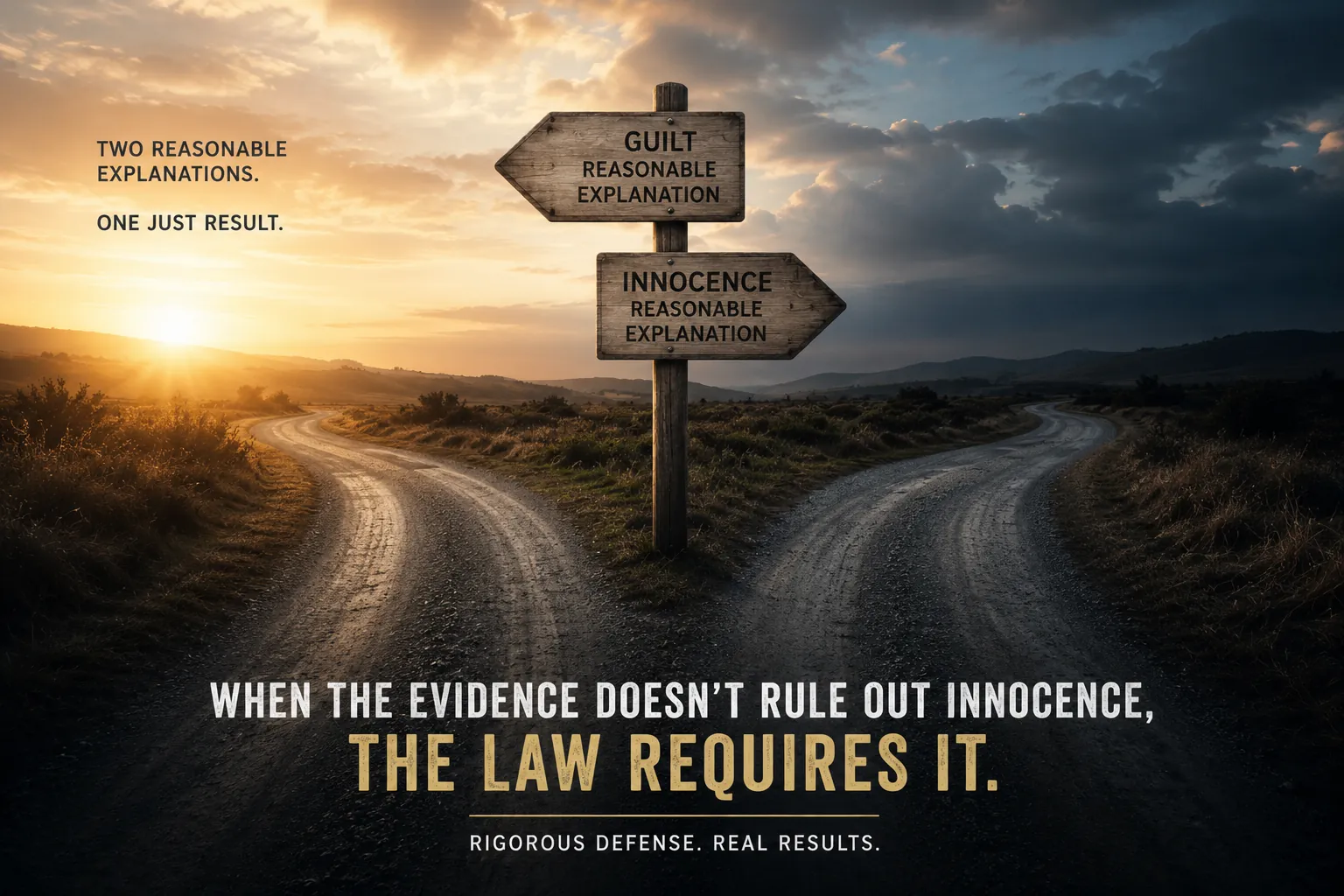
    How a Prison Weapon Case Ended Before Closing Argument

    A California criminal defense case handled by Redding criminal defense attorney Jacob Levin ended with the prosecution moving to dismiss the charge after cross-examination exposed a fundamental problem: the evidence did not rule out a reasonable explanation consistent with innocence.

    To protect the privacy of the individuals involved, this article does not use their real names. The client will be referred to as Mr. Smith, and the other inmate will be referred to as Mr. Jones.

    Sometimes a criminal case turns on DNA, fingerprints, surveillance video, or a dramatic eyewitness.

    Sometimes it turns on something much simpler.

    A plastic tote. A name on a label. And one question:

    Whose property was really inside it?

    My client, Mr. Smith, was charged with possession of a weapon in a penal institution. The prosecution’s case appeared straightforward. Officers searched property associated with a prison cell occupied by two inmates: Mr. Smith and Mr. Jones. Officers collected totes bearing the inmates’ names, including one labeled with Mr. Smith’s name. The officer testified that a suspected inmate-manufactured weapon was found during the search of Mr. Smith’s tote.

    But a label is evidence.

    It is not necessarily proof.

    And in a criminal case, the difference can be everything.

    Two Inmates. Two Totes. One Critical Assumption.

    The cell was assigned to two inmates: Mr. Smith and Mr. Jones. The evidence showed that the officers encountered a tote identified with Mr. Smith’s name and another associated with Mr. Jones. The labels were already on the totes when officers arrived; The Officer testified that he had not put them there.

    The prosecution’s theory depended on a seemingly natural inference: if Mr. Smith’s name was on the tote, the contraband inside it belonged to Mr. Smith.

    But criminal defense often requires asking a different question:

    What has the evidence actually ruled out?

    My defense theory was that Mr. Jones could have placed or stored contraband in the tote bearing Mr. Smith’s name.

    I did not have to prove that Mr. Jones did so. The important question was whether the prosecution’s evidence eliminated that reasonable possibility.

    That distinction became the focus of cross-examination.

    “Do You Have Any Evidence That Eliminates the Possibility?”

    During cross-examination, the Officer acknowledged that, other than the name on the tote, he could not recall finding anything inside the totes tying their contents to a particular inmate. He also agreed that nothing on either cellphone found during the investigation identified its owner.

    Then came the central issue.

    I asked whether it was possible that the items belonged to Mr. Jones.

    The officer initially said he found that difficult to believe—but acknowledged that it was possible.

    Then I narrowed the question:

    Did he have any evidence eliminating the possibility that the items belonged to Mr. Jones?

    His answer:

    “I don’t.”

    That was the heart of the defense.

    This approach reflects what trial consultant and author David Ball describes as a “rule out” method of examining proof. Instead of trying to establish every detail of an alternative story, the defense focuses on what the government’s investigation failed to eliminate.

    The question becomes less about proving what happened and more about whether the prosecution can rule out a reasonable explanation consistent with innocence.

    Then the Prosecution Pushed Back

    On redirect examination, the prosecution attacked the defense theory.

    The prosecutor emphasized that Mr. Smith’s name was on the tote. The argument was essentially common sense: isn’t someone’s name on a container evidence that the contents belong to that person?

    Even the court recognized the theoretical possibility that property inside a box bearing one person’s name could belong to somebody else.

    The prosecution then developed its own common-sense explanation. The contraband was valuable. Inmates generally protect their property. According to the officer, an inmate would not ordinarily want to place valuable contraband with somebody else’s property.

    That created the confrontation at the center of the case:

    Which explanation made sense?

    If You’re Hiding Contraband, Would You Put Your Name on It?

    On recross-examination, I returned to common sense.

    An inmate can have property in a cell that is not labeled. The officer agreed with that proposition.

    So I asked:

    Does it make sense to hide contraband and put your own name on it?

    The officer initially explained that hiding something “in plain sight” could make sense.

    Then I asked the more important question: wouldn’t it make more sense to hide contraband without putting your own name on it?

    The officer agreed:

    “That makes sense, yes.”

    The prosecutor responded again. His theory was also plausible: perhaps an inmate would label the tote as his because he expected the concealed contraband never to be discovered.

    The officer agreed that explanation could make sense too.

    At that point, something important had happened.

    The prosecution had a reasonable explanation.

    The defense had a reasonable explanation.

    So I asked one final question.

    “Would You Say That There’s Two Reasonable Explanations?”

    The prosecutor’s explanation made sense to the officer.

    My explanation made sense to the officer.

    I asked:

    If both explanations make sense, are there two reasonable explanations?

    The prosecutor objected, arguing that the question called for a legal conclusion.

    The judge overruled the objection.

    The officer answered:

    “Yes, there’s two.”

    That answer mattered because of a fundamental rule governing circumstantial evidence in California criminal cases.

    CALCRIM No. 224 and Two Reasonable Conclusions

    I had planned to make CALCRIM No. 224, California’s circumstantial-evidence instruction, a central part of closing argument.

    Under CALCRIM No. 224, before circumstantial evidence can support guilt, the jury must be convinced that guilt is the only reasonable conclusion supported by that evidence. When circumstantial evidence supports two or more reasonable conclusions—one pointing toward innocence and another toward guilt—the jury must accept the reasonable conclusion pointing toward innocence.

    That principle fit the defense precisely.

    The prosecution’s explanation: Mr. Smith labeled his own tote and concealed his own contraband inside it.

    The defense explanation: with two inmates sharing the cell, Mr. Jones could have stored contraband in the tote bearing Mr. Smith’s name—and the investigation had not produced evidence eliminating that possibility.

    The officer had now agreed that there were two reasonable explanations.

    I was preparing to take that testimony directly into closing argument.

    I never got the chance.

    The Prosecution Moved to Dismiss

    After the officer’s testimony, the prosecution moved to dismiss the case.

    There would be no need for the closing argument I had prepared around CALCRIM No. 224.

    The case was over.

    For my client, the distinction between an assumption and proof had become decisive.

    Criminal Defense Means Testing What the Evidence Does Not Prove

    This case illustrates something important about criminal defense.

    Evidence can look powerful at first glance.

    A weapon found in a tote bearing the defendant’s name certainly creates an inference. A prosecutor can argue from that fact. A jury can consider it.

    But the existence of incriminating evidence is not the end of the analysis.

    A criminal defense attorney must examine the assumptions connecting the evidence to the accusation.

    Does the evidence prove possession?

    Does it prove knowledge?

    Does it identify who actually placed an item somewhere?

    Did investigators rule out other reasonable explanations?

    And perhaps most importantly:

    Is the prosecution’s explanation the only reasonable explanation?

    Those questions can change a case.

    Redding Criminal Defense Attorney Jacob Levin

    Jacob Levin is a Redding criminal defense attorney representing people accused of crimes in Northern California. At Jacob Levin Law, criminal cases are examined not only for what the prosecution’s evidence appears to show, but also for the assumptions, unanswered questions, and reasonable alternative explanations that may exist beneath the surface.

    If you are facing criminal charges and are looking for a criminal defense lawyer in Redding, California, contact Jacob Levin Law to discuss your case.

    Every criminal case is different, and past results do not guarantee future outcomes. The names used in this article have been changed to protect privacy. The result described above is based on the particular facts and circumstances of that case.
  • What Proof Do You Need to Get a Restraining Order in California?

    What Proof Do You Need to Get a Restraining Order in California?

    Show me the proof!

    What Proof Do You Need to Get a Restraining Order in California?

    The proof required for a restraining order in California depends on the type of order requested. Domestic violence, civil harassment, and elder abuse restraining orders have different legal requirements and burdens of proof.

    Evidence may include testimony, text messages, emails, photographs, videos, medical records, financial records, and witnesses. A police report or physical injury is not always required. In some cases, credible testimony alone may be sufficient.

    Temporary Orders Versus Permanent Orders

    A temporary restraining order is usually decided based on the petitioner’s written declaration before the respondent has presented evidence. The petitioner generally must provide reasonable proof of past abuse or harassment. A civil harassment petitioner must also show that great or irreparable harm may occur without temporary protection.

    At the full hearing, both sides may testify, present evidence, call witnesses, and cross-examine the other party. The judge then applies the final burden of proof required for that particular restraining order.

    Domestic Violence Restraining Orders

    A domestic violence restraining order, or DVRO, applies when the parties have a qualifying relationship, such as spouses, former dating partners, close relatives, or people who share a child.

    At the hearing, abuse must generally be proven by a preponderance of the evidence—meaning it is more likely than not that the abuse occurred.

    Domestic violence is broadly defined. It can include physical violence, threats, stalking, coercive control, destroying property, repeated unwanted contact, or disturbing the other person’s peace.

    “Disturbing the peace” means conduct that destroys another person’s mental or emotional calm. Depending on the circumstances, this may include controlling finances, monitoring communications, isolating someone from family, threatening to disclose private information, or interfering with personal freedom. Physical violence is not required.

    Civil Harassment Restraining Orders

    A civil harassment restraining order, or CHRO, generally applies when the parties do not have the relationship required for a DVRO.

    A CHRO may be based on one of three grounds:

    1. Unlawful violence, such as an assault or battery.
    2. A credible threat of violence that reasonably causes fear for someone’s safety.
    3. A course of conduct consisting of repeated acts that seriously alarm, annoy, or harass someone and serve no legitimate purpose.

    At the full hearing, civil harassment must be proven by clear and convincing evidence. This is a higher standard than the preponderance standard used in DVRO cases.

    A CHRO based on a course of conduct generally requires more than one unpleasant encounter. The conduct must cause a reasonable person to suffer substantial emotional distress and must actually cause substantial emotional distress to the petitioner.

    This is different from “disturbing the peace” in a DVRO. Disturbing the peace means destroying someone’s mental or emotional calm. A CHRO course-of-conduct claim requires the more demanding showing of substantial emotional distress, repeated conduct, and no legitimate purpose.

    Elder Abuse Restraining Orders

    An elder abuse restraining order, or EARO, protects people age 65 or older and certain dependent adults.

    Elder abuse can include:

    • Physical abuse
    • Neglect or abandonment
    • Isolation
    • Financial abuse
    • Deprivation of necessary goods or services
    • Conduct causing physical harm, mental suffering, or serious emotional distress

    At the full hearing, elder abuse is generally proven by a preponderance of the evidence.

    The necessary proof depends on the allegation. Physical abuse may be shown through photographs or medical records. Financial abuse may require bank statements, deeds, or transfer records. Isolation may be shown through blocked calls, restricted visits, or testimony about the elder’s wishes.

    Speak With a Redding Restraining Order Lawyer

    The central question is not simply whether the conduct was upsetting. The evidence must satisfy the particular legal definition and burden of proof for the order being requested.

    Attorney Jacob Levin has litigated hundreds of restraining-order cases. If you need a Redding restraining order lawyer or representation in Shasta County or the surrounding Northern California courts, contact Jacob Levin Law to discuss your case.

  • Why You Should Hire a Restraining Order Lawyer Instead of Representing Yourself

    Why You Should Hire a Restraining Order Lawyer Instead of Representing Yourself

    If you are involved in a restraining order case, it is easy to think, “I’ll just tell the judge what happened.” Unfortunately, that is often where people get into trouble.

    Why You Should Hire a Restraining Order Lawyer Instead of Representing Yourself

    As a restraining order attorney in Redding, I have represented clients in hundreds of restraining order hearings throughout Northern California. I have also watched countless people represent themselves. Some do a decent job. Many make mistakes that permanently affect their gun rights, their families, and their finances.

    Whether you are requesting a restraining order or defending against one, here are some of the biggest reasons why hiring an experienced restraining order lawyer in Redding can make an enormous difference.

    1. Sometimes the Best Case Is the One That Never Gets Filed

    One of the biggest mistakes I see happens before anyone ever walks into the courtroom.

    People are often emotional after an argument and believe the answer is to file for a restraining order. But after carefully reviewing the facts, an experienced attorney may advise against filing one at all.

    In some cases, there simply is not enough evidence to meet the legal standard. In others, filing may escalate the conflict, create unnecessary litigation, or expose the person filing to paying the other side’s attorney’s fees.

    I have seen people spend thousands of dollars in attorney fees that could have been avoided with one consultation before filing.

    Often, good legal advice is knowing when not to file.

    2. The Rules of Evidence Matter

    Many people assume restraining order hearings are informal.

    They are not.

    Although judges may allow some flexibility, California’s rules of evidence still matter. A skilled restraining order attorney in Redding knows when evidence is admissible and when it is not.

    Common issues include:

    • Hearsay
    • Authentication of text messages
    • Foundation for photographs and videos
    • Relevance
    • Speculation

    Many self-represented litigants never object because they simply do not know they can.

    On the other hand, they may also fail to respond when the other side objects to their own evidence.

    3. Witnesses Can Win or Lose a Case

    One of the most common mistakes I see is people showing up alone.

    They assume the judge will simply believe them.

    Sometimes the most persuasive evidence comes from someone who saw what happened, heard the conversation, or observed the parties afterward.

    An experienced restraining order lawyer in Redding knows:

    • Which witnesses actually help
    • Which witnesses can hurt your case
    • How to subpoena reluctant witnesses
    • How to question them effectively
    • How to prepare them before they testify

    Witness preparation is often the difference between testimony that is powerful and testimony that unintentionally damages your case.

    4. Technology Problems Can Destroy Important Evidence

    Every lawyer has seen it happen.

    Someone tells the judge:

    “I have the video right here.”

    Then they cannot get it to play.

    Or it is stored in the cloud.

    Or the courthouse equipment cannot read the file.

    Or the audio will not work.

    Sometimes the video is never admitted because no proper foundation was laid.

    A restraining order lawyer prepares all of this beforehand so that critical evidence is actually available when the judge needs to see it.

    5. Cross-Examination Is a Skill

    Most people think their job is simply to tell their side of the story.

    Often, the more important job is exposing weaknesses in the other side’s testimony.

    Cross-examination requires planning.

    It requires understanding contradictions, prior statements, documents, text messages, timelines, and human psychology.

    As a restraining order attorney in Redding, I spend significant time preparing cross-examinations because many cases are won by asking the right questions—not by giving longer speeches.

    6. Knowing What the Judge Actually Needs

    Many self-represented parties spend twenty minutes talking about every disagreement they have ever had.

    The judge usually has one question:

    Has the legal standard for issuing a restraining order been met?

    Not every rude comment.

    Not every argument.

    Not every unpleasant interaction.

    A lawyer understands which facts actually satisfy the law and which facts are merely distractions.

    Keeping the hearing focused often makes your strongest evidence stand out.

    7. Deadlines Matter

    Restraining order cases have filing deadlines, service requirements, witness disclosure issues, and procedural rules.

    Missing a deadline can mean:

    • Evidence is excluded.
    • A continuance is denied.
    • Witnesses cannot testify.
    • Important documents are never considered.

    An experienced restraining order lawyer in Redding helps ensure these procedural requirements are met before the hearing ever begins.

    8. Family Law Consequences Can Last for Years

    Many people think restraining orders are only about staying away from someone.

    They often have no idea how many other consequences can follow.

    Depending on the circumstances, a restraining order can affect:

    • Child custody
    • Firearm rights
    • Employment
    • Professional licensing
    • Background checks
    • Housing opportunities

    A decision made in one hearing may affect multiple areas of your life.

    9. Attorney’s Fees Are a Real Risk

    Many people are surprised to learn that California courts can order one party to pay the other party’s attorney’s fees in certain restraining order proceedings.

    A person who files a weak or unsupported case—or defends one poorly—may end up paying far more than they expected.

    Good legal advice at the beginning can often prevent expensive mistakes later.

    10. Settlement Is Sometimes the Best Outcome

    Not every restraining order case needs a trial.

    Sometimes a negotiated resolution protects everyone involved while avoiding the uncertainty, stress, and expense of litigation.

    An experienced restraining order lawyer can often negotiate solutions that self-represented parties never realize are available.

    Experience Matters

    Restraining order hearings may appear simple, but they often involve complicated legal issues, evidentiary objections, witness examinations, and significant long-term consequences.

    I have handled hundreds of restraining order cases in Northern California. Every case is different, but one thing remains consistent: preparation matters.

    If you are looking for a restraining order attorney in Redding or a restraining order lawyer in Redding, obtaining experienced legal advice before your hearing may be one of the most important decisions you make. Whether you are seeking protection or defending against allegations, having someone who understands both the law and the courtroom can make a meaningful difference in the outcome.

  • The Most Dangerous Words in Criminal Defense

    The Most Dangerous Words in Criminal Defense

    The Most Dangerous Words in Criminal Defense: “We Already Know What Happened.

    The Most Dangerous Words in Criminal Defense

    Why Good Police Officers Can Still Reach the Wrong Conclusion

    When someone is arrested, it’s common to hear, “The police already know what happened.” But as a criminal defense attorney in Redding, I can tell you that those may be the most dangerous words spoken in a criminal case.

    The vast majority of police officers are hardworking, honest professionals who genuinely want to solve crimes and protect the public. The problem isn’t usually bad faith. The problem is something all human beings share: once we believe we’ve found the answer, it’s remarkably difficult to keep an open mind.

    Psychologists call this confirmation bias. Once we form a conclusion, we naturally begin noticing evidence that supports it while unintentionally giving less attention to facts that point in another direction. It isn’t dishonesty—it is simply how the human brain works.

    Imagine putting together a thousand-piece puzzle. If someone tells you the finished picture is a lighthouse, every blue piece suddenly looks like ocean and every gray piece looks like rocks. But if the puzzle was actually a mountain landscape, those same pieces tell an entirely different story. The pieces haven’t changed—only your assumption has.

    Criminal investigations can work the same way.

    Once investigators decide who committed a crime, every interview, every text message, every witness statement, and every piece of physical evidence may begin to be interpreted through that lens. Witnesses who support the theory seem credible. Witnesses who contradict it become confused, mistaken, or unreliable. Innocent explanations may never receive the same level of investigation.

    This does not mean the police acted improperly. In fact, many investigations are conducted professionally and thoroughly. But even excellent investigators are human, and human beings naturally seek patterns that confirm what they already believe.

    That is precisely why our legal system has defense attorneys, judges, juries, rules of evidence, and the constitutional right to cross-examine witnesses. The criminal justice system was never designed to simply accept the first explanation offered. It was designed to test it.

    As a Redding criminal defense attorney, I don’t begin by asking, “How can I explain my client’s conduct?” I begin by asking a different question:

    “What assumptions is everyone making?”

    Sometimes those assumptions are correct. Sometimes they are not.

    A witness who “positively identifies” someone may have viewed the suspect for only a few seconds in poor lighting. A confession may have followed hours of questioning. DNA may establish contact but not criminal intent. A suspicious text message may make perfect sense once the surrounding conversation is examined. Context matters.

    History is filled with wrongful convictions that did not occur because investigators were evil or because jurors were careless. Many occurred because everyone involved became convinced they already knew what happened before every piece of evidence had been fairly examined.

    That’s why I approach every case with healthy skepticism—not skepticism of people, but skepticism of conclusions that haven’t been thoroughly tested.

    One of my favorite verses captures this idea perfectly:

    “The one who states his case first seems right, until the other comes and examines him.”
    — Proverbs 18:17

    That verse isn’t just ancient wisdom; it describes the very purpose of a criminal trial. The first story often sounds convincing. The real test comes when someone asks the difficult questions.

    If you’re facing criminal charges in Shasta County or anywhere in Northern California, you deserve more than someone who assumes the government’s version of events is correct. You deserve an attorney willing to challenge assumptions, examine every piece of evidence, and ask the questions that no one else has asked.

    Because in criminal defense, justice is rarely found by accepting the first story.

    It’s found by examining it.

  • New Restraining Order Law

    New Restraining Order Law

    Insist on a full and fair hearing.

    New Restraining Order Law

    New California Case Protects the Right to a Full Domestic Violence Restraining Order Hearing

    When someone seeks a Domestic Violence Restraining Order (DVRO), they are often asking the court to make decisions that will profoundly affect their safety, family, and future. Likewise, a person accused of abuse has the right to present a complete defense before significant restrictions are imposed.

    A recent California Court of Appeal decision, In re Marriage of G.E. & I.D., reinforces an important principle: courts should decide restraining order requests based on the evidence—not because they run out of time on the court’s calendar.

    The Case

    In In re Marriage of G.E. & I.D., the petitioner sought a domestic violence restraining order alleging years of abuse and coercive control. The trial court issued a temporary restraining order and began hearing testimony.

    As the hearing continued over multiple court dates, the judge ultimately dismissed the petition before all of the evidence had been presented, citing concerns about the amount of court time the matter had consumed.

    The California Court of Appeal reversed.

    What the Court Held

    The Court of Appeal made clear that trial courts cannot dismiss a pending DVRO petition simply because it has taken too long or because of calendar congestion.

    Instead, courts must decide these cases on their merits after giving the parties a meaningful opportunity to present their evidence.

    The decision emphasizes that the Domestic Violence Prevention Act exists to protect litigants and that administrative convenience cannot override those statutory protections.

    Why This Matters

    Restraining order hearings often involve:

    • Conflicting testimony.
    • Text messages, emails, and social media evidence.
    • Witness testimony.
    • Audio and video recordings.
    • Complex questions regarding credibility.

    Many of these cases cannot be fairly resolved in a single afternoon.

    This decision recognizes that justice requires sufficient time for the court to hear the evidence before making a ruling.

    What This Means for You

    If you are requesting a restraining order, this case helps ensure that your petition will not be dismissed simply because the hearing takes longer than expected.

    If you are defending against a restraining order, the decision is equally important. It reinforces your right to fully present your defense and have the court decide the case based on the evidence—not scheduling concerns.

    In either situation, both sides deserve a fair hearing.

    Experienced Representation Matters

    Restraining order proceedings can have life-changing consequences. A restraining order may affect:

    • Child custody and visitation.
    • Firearm rights.
    • Employment opportunities.
    • Professional licenses.
    • Housing.
    • Reputation.
    • Immigration consequences in some cases.

    An experienced attorney understands not only the substantive law but also the procedural rules that protect your right to a fair hearing.

    If you are Looking for a Restraining Order Lawyer

    At Jacob Levin Law, we have extensive experience representing clients in contested restraining order hearings throughout Northern California. Whether you are seeking protection or defending against allegations, we work to ensure that the court hears all of the relevant evidence and that your rights are fully protected.

    I

    f you need assistance with a domestic violence restraining order or another type of restraining order in Redding, contact Jacob Levin Law to discuss your case.

  • Digital Evidence in Restraining Order Cases

    Digital Evidence in Restraining Order Cases

    Screenshots, Ring Cameras, and Deleted Messages: Digital Evidence in Restraining Order Cases

    Digital Evidence in Restraining Order Cases

    Restraining order cases often involve two very different accounts of the same event. One person describes threatening or unwanted conduct. The other says the contact was harmless, exaggerated, or taken out of context.

    Digital evidence can help the court determine what actually happened. Text messages, Ring camera footage, voicemails, emails, and call records often become some of the most important evidence in a California restraining order hearing.

    As a Redding restraining order lawyer, I carefully examine not only what the digital evidence shows, but also what may have been omitted.

    Screenshots May Not Tell the Whole Story

    Screenshots can document threats, repeated contact, apologies, or admissions. But they are also easy to crop.

    A message may appear threatening when viewed by itself but have a different meaning when the entire conversation is considered. Sometimes the most important evidence is the message immediately before or after the screenshot presented to the court.

    When reviewing screenshots, I look for:

    • Missing dates or timestamps
    • Gaps between messages
    • Cropped portions of the conversation
    • Unclear telephone numbers or account names
    • Messages inconsistent with the allegations
    • Continued communication by both parties

    California law generally allows the opposing party to introduce additional portions of a conversation when necessary to prevent a selected excerpt from creating a misleading impression.

    Can the Screenshot Be Authenticated?

    A screenshot does not automatically prove who sent the message. The name displayed at the top of the screen may simply be a contact name entered by the phone’s owner.

    Digital evidence generally must be authenticated before it can be admitted. This means there must be sufficient evidence showing that the message, photograph, or recording is what someone claims it is.

    Authentication may come from the telephone number, the surrounding conversation, the sender’s writing style, information known only to the parties, or testimony from someone familiar with the communication. If the sender denies writing the message, preserving the original device and complete message thread may become especially important.

    Ring Cameras Can Confirm—or Contradict—the Allegations

    Doorbell cameras and home-security systems can be particularly powerful in restraining order cases. A petition may allege that someone screamed, pounded on a door, tried to enter a home, or refused to leave. The video may confirm those allegations.

    It may also show that the person knocked once, waited briefly, spoke calmly, and left.

    Still, video does not always show the entire event. Motion activation may cause the recording to begin late or stop early. The camera may capture only part of the property, and timestamps are not always accurate. A short clip should therefore be examined in the context of the complete recording and the surrounding events.

    Because many security systems automatically delete old footage, important recordings should be downloaded and preserved immediately.

    Deleted Messages May Still Be Recoverable

    Deleting a message does not necessarily make it disappear. Copies may still exist:

    • On the other person’s phone
    • In screenshots
    • On a synchronized tablet or computer
    • In a cloud backup
    • In notification previews
    • In messages forwarded to someone else

    If a person claims to have produced the complete conversation but deleted unfavorable portions, that may affect the person’s credibility. At the same time, a missing message does not always establish intentional destruction. Evidence must be evaluated carefully before conclusions are drawn.

    Preserve the Evidence and Avoid Creating New Problems

    If you anticipate a restraining order case:

    • Do not delete messages, photographs, or recordings.
    • Save the complete conversation rather than selected excerpts.
    • Download original videos before they expire.
    • Preserve the original phone or device when possible.
    • Do not edit or crop the only available copy.
    • Never contact the other party in violation of a temporary order.

    Trying to obtain “one more message” from the opposing party can make the situation worse. Once a temporary restraining order prohibits contact, even a calm or well-intentioned communication may constitute a violation.

    Speak With a Redding Restraining Order Lawyer

    Digital evidence can expose exaggerations, establish a pattern of unwanted contact, or reveal that an allegation was taken out of context. But presenting that evidence effectively requires more than printing a few screenshots.

    As a Redding restraining order lawyer, I regularly examine messages, videos, emails, and other electronic records for missing context, inconsistent dates, selective editing, and statements that contradict the allegations. If you are seeking or defending against a restraining order in Redding or Shasta County, preserve your digital evidence as soon as possible. The clearest account of what happened may already be sitting on a phone or behind a doorbell camera.

  • How I Beat a Murder Charge by Questioning Assumptions

    How I Beat a Murder Charge by Questioning Assumptions

    This Case Taught Me a Lot About Assumptions

    How I Beat a Murder Charge by Questioning Assumptions

    How I Beat a Murder Charge: Sometimes the Most Important Question Is “Did My Client Really Cause the Death?”

    When most people think of a murder case, they picture someone who causes another person’s death directly—a shooting, a stabbing, or a fatal beating. But not every case is that simple.

    I recently defended a client who was charged with murder after another man died more than six weeks after a fight. The prosecution claimed the fight started a chain of events that ultimately led to the man’s death. At first glance, that sounded straightforward.

    It wasn’t.

    The more I dug into the evidence, (if you’re picturing me late at night, surrounded by files, coffee, and a desk lamp, like in an 80s movie, you’d be right) the more I realized the prosecution’s theory wasn’t built on proof. It was built on assumptions. My job was to separate those assumptions from the actual evidence.

    The Prosecution’s Theory

    The prosecution alleged that my client assaulted the victim, causing a broken hip.

    The victim underwent hip replacement surgery. Weeks later, he developed what the prosecution claimed was a MRSA infection. According to the medical examiner, that infection turned into sepsis, which caused the victim’s death.

    Therefore, they argued, my client committed murder.

    The problem was that every step in that chain required proof—and several of those links simply didn’t exist.

    I Looked at the Medical Evidence

    The prosecution’s entire murder theory depended on one proposition:

    The victim died from MRSA sepsis that resulted from surgery caused by the assault.

    So I asked a simple question:

    Did the medical evidence actually prove that?

    It didn’t.

    The preliminary hearing testimony contained several significant gaps.

    The medical examiner acknowledged that infections can enter the body in different ways. He admitted he could not rule out that the victim already had an infection before hospitalization. He admitted he couldn’t say exactly where or when the infection was acquired. He admitted treatment could have worked had the victim returned to the rehabilitation facility as instructed.

    Those admissions alone created serious problems with the prosecution’s theory of causation.

    Then the Records Became Even More Interesting

    I obtained the underlying laboratory records and autopsy materials the medical examiner had relied upon.

    Those records raised even more questions.

    The prosecution repeatedly referred to a deadly MRSA infection.

    But the postmortem cultures did not actually identify MRSA. They identified ordinary Staphylococcus aureus without documented methicillin resistance. Multiple other organisms were also present, raising legitimate questions about whether the cultures reflected postmortem changes rather than the cause of death itself.

    In other words, the testimony at the preliminary hearing was considerably stronger than the underlying medical records themselves.

    That distinction matters. A criminal charge—especially murder—cannot rest upon conclusions that aren’t supported by the underlying evidence.

    The Victim Made His Own Medical Decisions

    Another issue received surprisingly little attention.

    After surgery, the victim developed an infection.

    Doctors performed another procedure and recommended that he return to a skilled nursing facility for several weeks of intravenous antibiotics.

    He refused.

    Instead, he went home.

    According to the evidence, he never returned for follow-up care.

    He apparently left the wound untreated while living in an extremely unsanitary environment.

    Even the medical examiner acknowledged that continued treatment could have cured the infection.

    That raised an important legal question.

    At what point does someone else’s independent decision become the real cause of the outcome?

    California law recognizes that not every event following an assault remains legally attributable to the original defendant. Sometimes later events become so independent and so significant that they break the chain of legal causation.

    I did not really raise that issue, but I had it in my back pocket if we went to trial.

    There Was One More Major Problem

    The victim suffered from severe cardiovascular disease.

    Two major coronary arteries were completely blocked.

    He also suffered from chronic obstructive pulmonary disease (COPD).

    Even the medical examiner acknowledged those conditions could worsen infections.

    The Turning Point

    I retained an independent forensic pathologist who concluded that the medical evidence actually pointed toward sudden cardiac death from severe cardiovascular disease rather than proven MRSA sepsis. He also noted the absence of microscopic findings typically associated with sepsis and explained why the postmortem bacterial findings were medically questionable.

    The prosecution had treated one possible explanation as though it were the only explanation.

    In criminal law, that’s not enough.

    Criminal Cases Are Built One Link at a Time

    One of the themes I emphasized throughout the case was simple:

    The prosecution’s theory only worked if every link in its chain held together.

    They had to prove:

    • my client caused the hip fracture;
    • the fracture required surgery;
    • the surgery caused the infection;
    • the infection was actually MRSA;
    • the MRSA entered the bloodstream;
    • the infection—not other medical conditions—caused death; and
    • nothing afterward broke the chain of causation.

    When I examined each link individually, several were unsupported.

    When enough links fail, the entire chain fails.

    Why This Matters

    People often assume criminal defense lawyers simply argue that their clients “didn’t do it.”

    That’s rarely how serious cases work.

    Sometimes the fight is over intent.

    Sometimes it’s identification.

    Sometimes it’s constitutional rights.

    And sometimes, as in this case, it’s something far more technical: whether the prosecution can actually prove that one event legally caused another.

    Medical causation cases are among the most challenging cases in criminal law because they require understanding both the law and the underlying science. You have to know how to cross-examine medical experts, read laboratory records, understand pathology reports, and identify when a conclusion goes beyond what the evidence actually proves.

    That’s exactly what I did here.

    When someone’s freedom depends on whether the prosecution can prove every element of murder, assumptions aren’t enough. Evidence is.

  • New Domestic Violence Restraining Order Rule Just Came Out

    New Domestic Violence Restraining Order Rule Just Came Out

    It’s Important to Stay Current with any Legal Developments

    New Domestic Violence Restraining Order Rule Just Came Out

    The California Supreme Court Just Changed the Rules for Lawyers in Domestic Violence Cases—Here’s What That Means for You

    When someone is served with a domestic violence restraining order, the experience can be overwhelming. Many people have never been involved in the court system before and suddenly find themselves facing a hearing that could affect where they live, whether they can see their children, and even whether they may lawfully possess firearms.

    Recognizing the seriousness of these proceedings, the California Supreme Court recently amended the Rules of Professional Conduct to prohibit attorneys from soliciting respondents in certain domestic violence restraining order cases before they have been formally served. The change reflects an important principle: restraining order proceedings are significant legal matters that deserve fairness and integrity from the very beginning.

    For anyone facing a restraining order, the lesson is simple: don’t hire the first lawyer who contacts you. Instead, take the time to find the attorney who is best qualified to protect your rights.

    Why the Rule Changed

    Temporary domestic violence restraining orders are often issued before the respondent has an opportunity to tell their side of the story. Because these orders are issued on an emergency basis, the respondent is typically served afterward and then given an opportunity to file a response and to appear at a later hearing.

    The California Supreme Court’s new rule is designed to prevent attorneys from contacting respondents before they have even been served with the temporary order. The concern is that premature solicitation could interfere with the service process and, in some situations, create additional safety concerns.

    Regardless of which side of a restraining order case you are on, the court wants the legal process to be fair and orderly.

    Don’t Make a Decision Out of Panic

    One of the biggest mistakes people make after learning that a restraining order has been filed is hiring the first attorney they find—or the first one who contacts them.

    That reaction is understandable. A restraining order can have immediate and long-lasting consequences, including:

    • Orders to stay away from your home, workplace, or family members.
    • Restrictions on child custody and visitation.
    • Mandatory surrender of firearms.
    • Damage to your personal and professional reputation.
    • Lasting effects on employment, professional licensing, and future court proceedings.

    These are too important to entrust to someone without carefully considering your options.

    Not Every Attorney Regularly Handles Restraining Order Cases

    Restraining order hearings are unique. They move quickly, involve different evidentiary rules than many other civil proceedings, and often turn on witness credibility.

    Many attorneys may handle only a handful of restraining order cases each year. Others focus their practice on entirely different areas of law.

    When choosing a Redding restraining order attorney, consider asking questions such as:

    • How many restraining order hearings have you handled?
    • Do you represent both petitioners and respondents?
    • Have you conducted contested evidentiary hearings?
    • How often do you appear in Shasta County courts?
    • What strategy would you recommend for my particular situation?

    Experience matters, particularly in cases where credibility and cross-examination often determine the outcome.

    A Restraining Order Hearing Is More Than Just Telling Your Story

    Many people believe that if they simply tell the judge what happened, everything will work out.

    Unfortunately, court proceedings rarely operate that way.

    Success often depends upon:

    • Identifying weaknesses in the opposing party’s evidence.
    • Presenting documentary evidence effectively.
    • Cross-examining witnesses.
    • Understanding the legal requirements that must be proven.
    • Knowing which facts are legally significant and which are not.

    Preparation frequently makes the difference between a favorable outcome and an avoidable adverse ruling.

    Respond Quickly—But Choose Carefully

    If you have been served with a restraining order, do not ignore it. There are strict deadlines before the hearing, and waiting too long can limit your ability to prepare your defense.

    At the same time, there is no need to panic into hiring the first lawyer you encounter.

    Take time to research attorneys, read reviews, ask questions, and choose someone with substantial experience handling restraining order litigation.

    Staying Current Matters

    Restraining order law is not static. The California Legislature, appellate courts, and even the California Supreme Court periodically change the rules that govern these proceedings. As this recent amendment to the Rules of Professional Conduct demonstrates, developments in restraining order law can directly affect how these cases are handled. Because I litigate restraining order cases on a regular basis, I make it a priority to stay current on new statutes, court decisions, procedural changes, and ethical rules that may affect my clients. Whether representing a petitioner seeking protection or a respondent defending against allegations, remaining up to date with the latest developments is an important part of providing effective legal representation.

    An Experienced Redding Restraining Order Attorney Can Help

    Whether you are seeking protection or defending against allegations, restraining order proceedings deserve careful preparation and experienced legal representation.

    At Jacob Levin Law, we represent both petitioners and respondents in restraining order matters throughout Redding, Shasta County, and surrounding Northern California communities. We understand that every case has two sides, and we are committed to presenting our clients’ cases professionally, thoroughly, and effectively.

    If you have questions about a domestic violence restraining order, civil harassment restraining order, workplace violence restraining order, or gun violence restraining order, speaking with an experienced Redding restraining order attorney as early as possible can help you understand your rights and prepare for the hearing ahead.

  • One Unique Restraining Order Trial

    One Unique Restraining Order Trial

    These cases taught me a lot, hopefully they help you too.

    One Unique Restraining Order Trial

    Winning a Restraining Order Trial: Why Preparation Beats Panic Every Time

    When someone walks into court asking for a restraining order, it can be tempting to think the outcome depends on who tells the more emotional story. In reality, the law requires much more than that.

    This week, I represented two different respondents in two separate restraining order cases that were tried together. One involved a Domestic Violence Restraining Order (DVRO) and the other involved a Civil Harassment Restraining Order (CHRO). After the petitioners finished presenting their evidence, I made motions under Code of Civil Procedure section 631.8, asking the court to enter judgment because the evidence was legally insufficient. The court granted both motions and dismissed both petitions.

    The result wasn’t about a dramatic cross-examination (although I think I did that quite well 😊) or a surprise witness (even though I had one ready!).

    It came from careful legal research, thoughtful preparation, and building the facts before we ever stepped into the courtroom.

    Every Restraining Order Case Starts With One Question

    People often assume that if someone felt frightened, upset, or uncomfortable, a restraining order automatically follows.

    California law doesn’t work that way.

    Whether it’s a domestic violence restraining order or a civil harassment restraining order, courts must apply specific statutes and appellate decisions—not simply decide who appears more sympathetic.

    That’s why hiring an experienced restraining order lawyer can make an enormous difference.

    Knowing the Case Law Matters

    One of the biggest issues in the domestic violence case involved the difference between a true pattern of domestic abuse and an ordinary dispute between former dating partners.

    The petition described a disagreement over payment of a shared credit card after the relationship ended. The primary allegation was that my client went to the petitioner’s home to demand payment.

    Rather than simply arguing that my client “did nothing wrong,” I focused on what California appellate courts have already said.

    The trial brief explained why the facts were materially different from Burquet v. Brumbaugh, a case involving months of repeated unwanted contact and obsessive attempts to continue a romantic relationship. It also relied on Curcio v. Pels, where the Court of Appeal warned that the Domestic Violence Prevention Act was not intended to become a forum for resolving every disagreement between former couples.

    A Legitimate Purpose Can Change Everything

    The civil harassment case raised a different issue.

    California’s Civil Harassment statute specifically excludes conduct that serves a legitimate purpose from the type of harassment the law is designed to prevent.

    Here, even the petitioner’s own declaration acknowledged why my client contacted him: she believed money was owed on a credit card. The dispute was over a debt—not random harassment. By the time of trial, on my advice, the disagreement had already been filed in Small Claims Court, giving the parties a proper forum to resolve the financial issue.

    The law also recognizes that restraining orders are intended to prevent future harassment—not punish past disagreements. When an isolated dispute has ended and there is no evidence it is likely to happen again, that becomes an important legal issue. The brief addressed those principles using decisions such as Hansen v. Volkov and Russell v. Douvan.

    Good Investigation Wins Cases Before Trial

    Legal research alone isn’t enough.

    The facts have to support the law.

    One of the most valuable parts of preparing these cases was working with an investigator. Investigators often locate witnesses, verify timelines, obtain statements, and uncover information that would otherwise never make its way into the courtroom.

    In one of these cases, the investigation helped establish facts that directly contradicted important portions of the petitioner’s presentation. That gave the court a much clearer picture of what had actually happened.

    Preparation Makes Cross-Examination More Effective

    Many people picture trial as dramatic objections and aggressive questioning.

    In reality, effective cross-examination usually starts weeks before trial.

    Knowing the governing cases, understanding the statutory elements, organizing the evidence, and anticipating how each witness fits into the legal framework often matters more than asking clever questions in court.

    When the petitioner finishes presenting evidence, the judge isn’t deciding who gave the better performance.

    The judge is deciding whether the evidence satisfies the legal requirements.

    That’s exactly why a motion under Code of Civil Procedure section 631.8 exists.

    Choosing the Right Restraining Order Lawyer

    Every restraining order case is unique, but one principle remains consistent:

    Facts matter.

    Law matters.

    Preparation matters.

    Whether you’re seeking protection or defending against allegations, your attorney should understand not only the statutes, but also the appellate decisions that explain how those statutes actually work in real courtrooms.

    A knowledgeable restraining order attorney should be able to identify legal defenses, distinguish unfavorable cases, find favorable authority, and build the factual record needed to present those arguments effectively.

    Need Help With a Restraining Order Case?

    If you’ve been served with a restraining order—or you’re considering filing one—don’t assume the outcome depends solely on what happened. It often depends on how the law applies to those facts.

    At Jacob Levin Law, I represent clients throughout Redding and Northern California in both Domestic Violence Restraining Orders and Civil Harassment Restraining Orders. Every case is prepared with the same philosophy: investigate the facts thoroughly, research the law carefully, and present the strongest legal argument possible.

    Because in court, preparation is often what makes the difference.

  • “The One Who States His Case First Seems Right…”

    “The One Who States His Case First Seems Right…”

    "The One Who States His Case First Seems Right..."

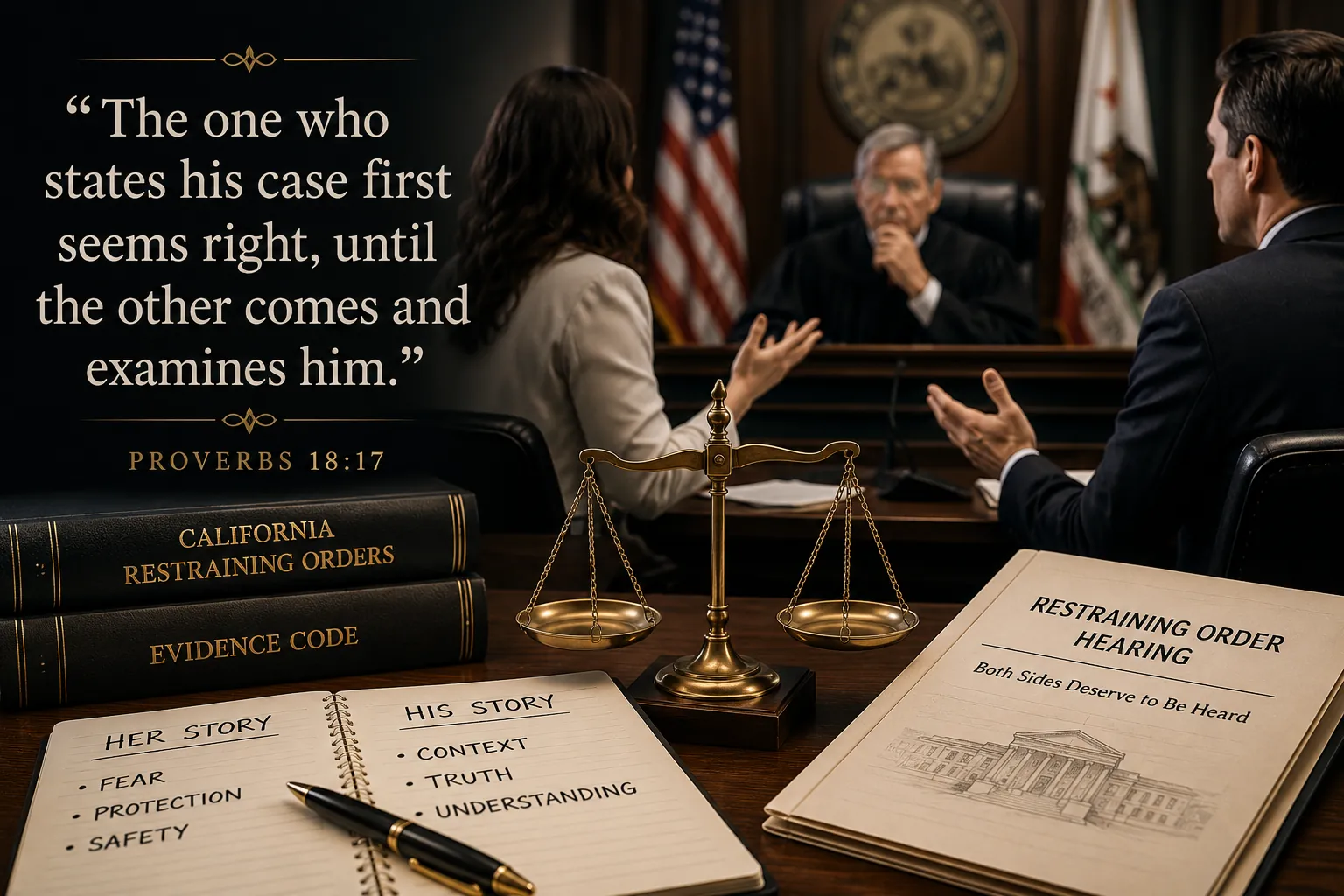
    “The One Who States His Case First Seems Right…” What Proverbs 18:17 Teaches Us About Restraining Order Hearings

    “The one who states his case first seems right, until the other comes and examines him.”
    — Proverbs 18:17

    More than 2,000 years ago, the Book of Proverbs captured a truth about human nature that remains just as relevant in today’s courtrooms as it was in ancient times.

    When we hear only one side of a story, that side often seems convincing.

    Only after hearing the other side do we begin to appreciate that the facts may be far more complicated.

    That principle lies at the heart of every restraining order hearing.

    Every Story Has Two Sides

    When someone files for a restraining order, the court initially hears only the petitioner’s version of events.

    That is why California courts may issue a Temporary Restraining Order (TRO) before the respondent has an opportunity to appear. At that early stage, the judge is deciding whether temporary protection is appropriate until a full hearing can be held.

    But the temporary order is not the end of the case.

    It is the beginning of it.

    The law recognizes an important principle: before issuing a longer-term restraining order, both sides deserve an opportunity to be heard.

    That is exactly what Proverbs 18:17 teaches.

    Why Cross-Examination Matters

    At the hearing, the respondent has the opportunity to present evidence, call witnesses, testify if appropriate, and cross-examine the petitioner’s witnesses.

    Cross-examination has long been recognized as one of the most effective methods for discovering the truth.

    Sometimes it confirms what was alleged.

    Other times it reveals misunderstandings, missing context, inconsistent statements, mistaken perceptions, or facts that were never included in the original petition.

    This does not mean that every restraining order petition lacks merit.

    Nor does it mean that every respondent has a valid defense.

    It simply recognizes that judges make better decisions when they hear both sides.

    First Impressions Are Powerful

    Human beings naturally form opinions quickly.

    Psychologists refer to this as the primacy effect—our tendency to give greater weight to the information we hear first.

    That is precisely why our legal system does not stop after hearing only one side.

    The court schedules a hearing.

    Evidence is presented.

    Witnesses are examined.

    Objections are made.

    Only then does the judge decide whether the petitioner has met the legal burden required for the particular type of restraining order being sought.

    Every Type of Restraining Order Has Different Rules

    Another common misconception is that every restraining order hearing follows the same legal standards.

    It does not.

    California recognizes several different types of restraining orders, including:

    • Domestic Violence Restraining Orders
    • Civil Harassment Restraining Orders
    • Elder Abuse Restraining Orders
    • Workplace Violence Restraining Orders
    • Gun Violence Restraining Orders

    Each has its own statutes, evidentiary rules, and burden of proof.

    Understanding those differences can significantly affect how a case is presented and how the court evaluates the evidence.

    A Hearing Is More Than Reading Declarations

    Many people assume the judge simply reads the written declarations and decides the case.

    In contested hearings, that is rarely enough.

    An experienced attorney knows when to:

    • Cross-examine witnesses.
    • Object to inadmissible evidence.
    • Challenge credibility.
    • Introduce documents, photographs, text messages, and videos.
    • Present testimony that provides important context.
    • Explain how the law applies to the specific type of restraining order before the court.

    Sometimes a single answer during cross-examination changes the entire direction of a hearing.

    Due Process Protects Everyone

    The wisdom of Proverbs 18:17 is not about favoring one side over the other.

    It is about recognizing that justice requires listening before deciding.

    Our legal system is built upon that same principle.

    Whether you are seeking protection through a restraining order or defending yourself against one, the court’s responsibility is to hear both sides, carefully examine the evidence, and apply the law fairly.

    That process protects petitioners.

    It protects respondents.

    Most importantly, it protects the integrity of the judicial system itself.

    Experience Matters

    Restraining order hearings often move quickly, but their consequences can last for years. They can affect firearm rights, child custody, employment, housing, professional licenses, and future court proceedings.

    Because each type of restraining order has different legal requirements, it is important to work with an attorney who understands not only the facts of your case, but also the specific statutes, evidentiary rules, and courtroom procedures that apply.

    At Jacob Levin Law, we represent both petitioners and respondents in restraining order proceedings throughout Redding, Shasta County, and Northern California. We believe every case deserves careful preparation, thoughtful advocacy, and, consistent with the wisdom expressed in Proverbs 18:17, a full and fair opportunity for both sides to be heard.